

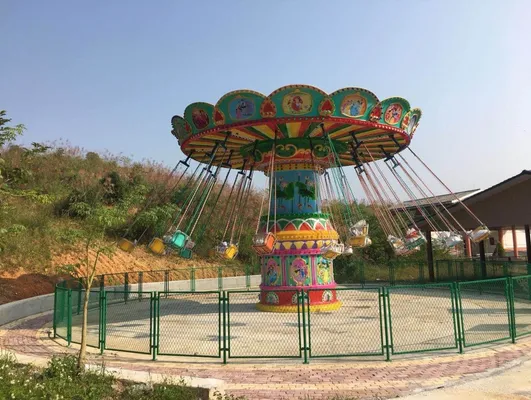
A trailer flying chair ride succeeds as a mobile anchor only when transport, setup, guest flow and operating controls are coordinated. A mobile carnival needs attractions that can be recognized from across a field and moved without turning every relocation into a construction project. A trailer-mounted flying chair has that potential: the rotating canopy and suspended seats create a visible silhouette, while the listed approximately ten-passenger configuration keeps the concept relatively compact. The real purchasing decision, however, lives in transport, assembly, utilities, inspection and throughput details.
The catalog describes this model as a trailer-mounted ride built from steel and fiberglass for carnivals, fairs, parks and mobile businesses. This article is a due-diligence guide, not an operating manual or a claim that the ride is approved for a particular jurisdiction. A prospective operator should obtain the exact technical package and involve the authorities and qualified professionals relevant to each intended location.
A project story: from empty space to purposeful play
Imagine a regional operator serving three town festivals in ten days. At one venue, the midway is paved; at another, the assigned plot is grass; at the third, access is through a low gate and the power distribution is shared. The flying chair is intended to be the family-facing anchor near the entrance. Its success depends on whether the trailer can enter and turn, the ride can be positioned and leveled as required, and the setup can be completed within the permitted window.
The visible ride footprint is only one layer. The plan also needs the tow vehicle and trailer route, setup working area, queue, operator position, control area, perimeter treatment and exit path. Lighting or decorative options may affect electrical planning. Treat the manufacturer’s final drawings and instructions as the basis for the plan; a product-page phrase such as ‘compact’ cannot answer a site engineer’s dimensional questions.
What the product data actually establishes
The following snapshot is limited to information supplied in the source catalog for this product. It is a useful briefing reference, not a substitute for the final quotation, technical drawings, manuals or local professional review.
- Listed capacity: Approximately 10 passengers
- Structure: Trailer-mounted flying chair ride
- Materials: Steel structure and fiberglass
- Movement: Rotating swing-chair motion
- Use cases: Carnivals, fairs, parks and mobile amusement businesses
Before relying on any figure, ask the supplier to connect it to the exact configuration being quoted. Custom colors, modules, dimensions or options can change the project interfaces. Keeping the approved product schedule, drawings and operating documents together also helps designers, installers and the future operations team work from the same information.
Plan the experience before fixing the layout
Start with a route audit. Record legal transport dimensions and weight from the supplied documents, tow requirements, turning envelope, road restrictions, storage height and whether special permissions apply. Then audit each venue: surface capacity and level, underground or overhead constraints, access, required clearances, electrical characteristics, drainage and emergency access. These checks should happen before the attraction is placed on a promotional map.
Next, model hourly operation conservatively. Listed passenger count alone does not equal throughput; loading, restraint checks, ride cycle, unloading and the needs of individual riders all affect the number. Draw the queue so waiting guests do not cross the exit or interfere with adjacent attractions. Decide how signage communicates eligibility and instructions, based on the final manual and local requirements rather than assumptions drawn from the ride’s family-oriented appearance.
Buyer questions that improve the project brief
A useful inquiry explains the site and intended operation instead of asking only for a price. Send measurements, photographs, user groups, preferred activities, opening context and known constraints. Then use the answers below as documented decision points. Any limit or technical requirement should come from the final product package and the professionals responsible for the actual site.
- Obtain exact operating, transport and setup dimensions and weights for the quoted configuration.
- Request foundation, leveling, anchoring or support requirements and the complete setup sequence.
- Confirm electrical load, voltage, frequency, connectors and any lighting or music options.
- Review passenger eligibility, restraints, operating limits and inspection points in the supplied manual.
- Clarify what training, installation support, spares and technical documents are included.
- Verify the approvals, inspections and insurance evidence required in every intended jurisdiction.
Installation, handover and everyday operation
A relocation checklist should follow the ride from storage to handover. Include pre-departure condition, trailer connection, load security, arrival photos, surface confirmation, assembly sign-offs and a controlled test according to supplied procedures. Assign roles so no critical step belongs to ‘whoever is free.’ If the vendor provides setup guidance, define its scope and language, travel responsibilities and acceptance criteria before shipment.
Routine operation needs an equally clear system: documented opening checks, controlled boarding, restraint verification, cycle supervision, weather monitoring, closure triggers and end-of-day inspection. Maintenance should follow the manufacturer’s schedule and use appropriate parts. A mobile format changes locations frequently; it does not reduce the need for location-specific authorization, competent staff or careful records.
Keep a controlled record of revisions from first concept through handover. At completion, reconcile the installed equipment with the approved component schedule and collect the documents, training records and contact routes that the operating team will need. This is also the right time to confirm which changes require supplier input rather than an improvised local modification.
For broader project research, explore our commercial amusement park equipment collection and the related family amusement ride planning guide.
Frequently asked questions
Does approximately 10 passengers mean 10 adults?
No such conclusion should be drawn from the listing. Obtain the final passenger eligibility, seat limits and loading rules for the quoted model and apply local requirements.
Is a trailer-mounted ride ready to operate immediately after parking?
The catalog describes quick setup, but positioning is only part of commissioning. Follow the exact leveling, support, assembly, connection, inspection and testing process supplied for the ride.
Can the voltage be customized?
The listing mentions custom voltage options and 50 Hz. Confirm all electrical characteristics for the destination and have the site supply reviewed by qualified professionals.
Why use this as an anchor attraction?
Its elevated rotating form can create a recognizable focal point. Commercial value still depends on the event mix, permitted operation, realistic throughput and total operating cost.
Discuss the exact product for your site
Visit the exact Trailer Flying Chair product page, then request the model-specific transport drawing, site plan, electrical schedule, operating manual and support scope before evaluating it for a mobile route. View Trailer Flying Chair Amusement Ride 10 Passenger Outdoor Carnival Equipment 100kg–500kg.